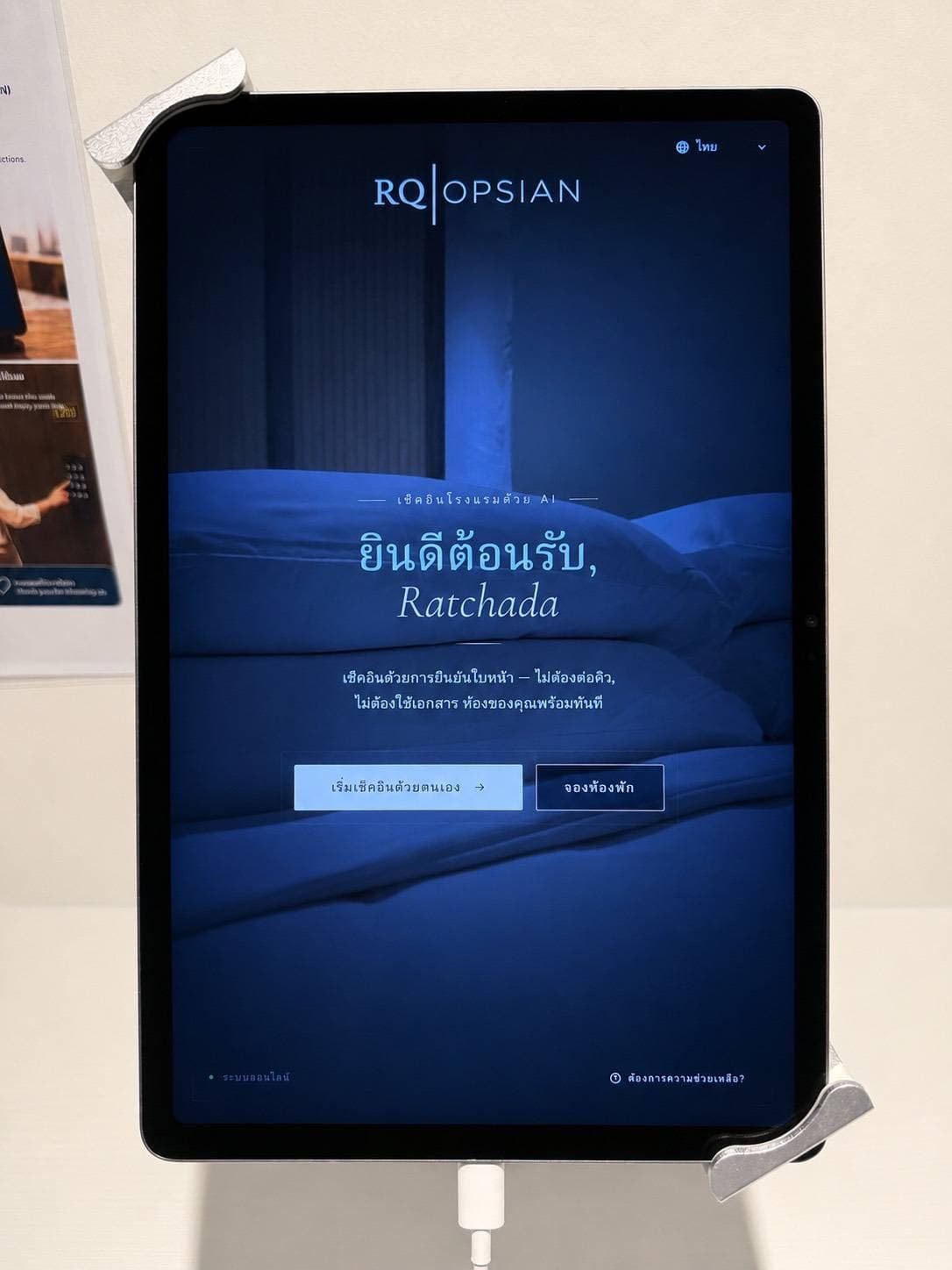
A hotel in Thailand has to tell Immigration about every foreign guest who stays with it. The process is known as TM30, "Inform Accommodation", and at most properties it is still a second job done after the first one: the guest is checked in, and later someone types the passport into a government form. ENTRIX, the identity and check-in system Opsian builds, prepares that record from the same scan that lets the guest in. Staff still file it. What changes is everything before the filing.
One flow, one record
The guest flow is short. The guest finds their booking and gives consent. They scan a passport, a Thai ID card or another identity document, which is read automatically. They pass a liveness check, and the selfie is matched to the portrait on the document.
Once that is done, ENTRIX checks the guest in on the property management system, issues door codes on the smart locks, and emails the guest in their own language.
The immigration data is captured inside that flow, not after it. The fields the TM30 template asks for come from the document that was just verified, so there is no second data entry and no second version of the guest's identity to reconcile later.
Prepared, not filed
It is worth being precise about what ENTRIX does and does not do. It does not file with Immigration. It exports the official immigration .xls template, populated from the verified record, and a member of staff files it. The work is export-assisted, not automated filing.
That boundary is deliberate. The legal duty sits with the property, and the act of filing stays with an accountable person. What the system removes is the part that produces errors: re-keying names, document numbers and dates from a photocopy, often at the end of a night shift.
A worklist built around the deadline
The registration work between March and June 2026 was organised around a single question staff ask every day: who still needs to be reported, and by when.
The answer is a day-scoped worklist with deadlines and overdue tracking. Thai nationals are exempt from the requirement, so they do not appear on it. Export is selective: staff choose which guests to include, and record a filing confirmation once the submission is made, so the list reflects what has actually been filed rather than what has been downloaded.
Some cases need a person's judgement. An expired passport is never filed without a staff acknowledgement. The system does not decide that case quietly in either direction; it stops and asks.
Closing the gaps the desk used to absorb
Most of the later work addressed the cases that used to fall outside the system and back onto the front desk.
On 29 July, registration was extended to guests checked in manually at the desk. They can now be filed from the same worklist as everyone else.
On 12 and 13 August, an AI backfill was added for incomplete records. It fills only fields that are blank, never overwriting a value that is already there, and it records where each value came from so staff can see what was read from the document and what was filled later. If it cannot complete a record reliably, it stops and leaves the record to staff.
On 31 August, Thai ID cards began filling nationality, document number and sex automatically, so the record is complete without anyone typing those fields.
What staff see
All of this sits in one staff dashboard. It handles verifications, failed scans and the immigration registration worklist. A failed scan is not a dead end at a kiosk; it is an item a person can pick up, with the partial record attached.
The guest side reaches the same standard in five languages: English, Thai, Chinese, Russian and Burmese, each at full parity. A guest who reads Burmese gets the same consent text, the same instructions and the same confirmation email as a guest who reads English.
Why it matters to an operator
For a property owner or general manager, the value is not that a form gets filled faster. It is that three things that used to depend on memory now depend on a record. The deadline is visible before it passes. The filing is built from the document that was verified, not from a copy of it. And when someone asks months later who stayed on a given night and whether they were reported, the answer is on the worklist, with the confirmation that it was filed.
That is the difference between a check-in that is faster and a check-in that is defensible. ENTRIX is built for the second. More on the product is at opsiantechnologies.com.