
Hotels in Thailand carry a heavier front-desk workload than most. Every foreign guest has to be reported to Immigration through the TM30 process within 24 hours of arrival, guests write on several messaging apps in several languages, and arrivals cluster at the hours when the desk is thinnest. AI for hotels in Thailand is most useful where it removes that repetitive work without taking accountability away from staff.
This article covers the three places where hotel automation in Thailand pays off first, using what runs at RQ | Opsian Hotels, the hotel brand of the RoomQuest and Opsian partnership, as the worked example.
Check-in with identity verification
The front desk's first job is confirming who the guest is. Done by hand, that means a passport, a photocopy and a queue. Done by a system, it can be one short flow on a kiosk tablet.
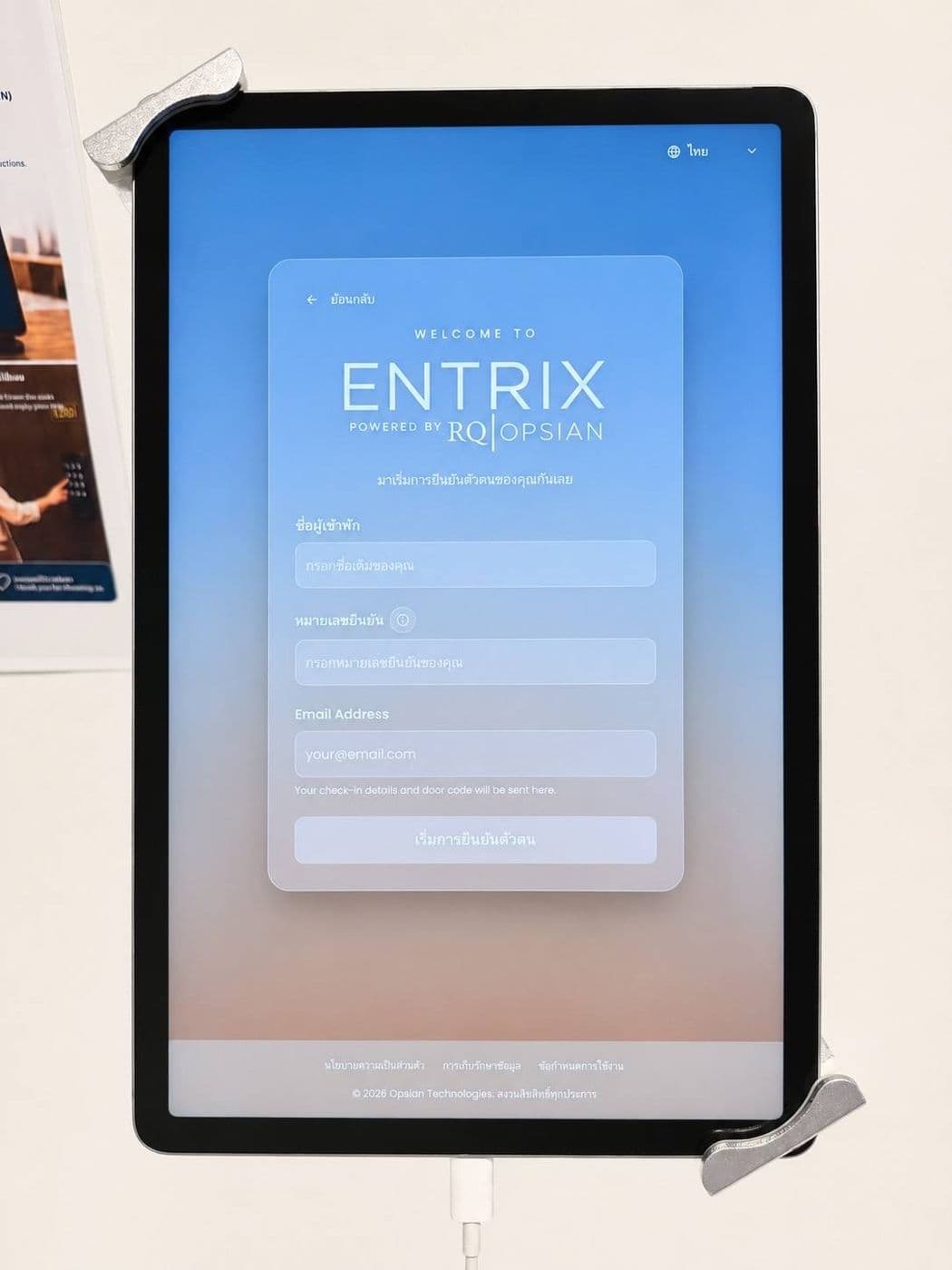
With ENTRIX, the identity and check-in system Opsian builds, the guest finds their booking and gives consent. They scan a passport, a Thai ID card or another identity document, which is read automatically. A liveness check confirms a live person is present, and the selfie is matched to the portrait on the document. Once the checks pass, ENTRIX checks the guest in on the property management system, issues a door code on the smart lock and emails the guest in their own language.
ENTRIX is live across all RQ | Opsian Hotels properties. During final testing against live arrivals, the pilot properties measured a 73 percent reduction in front-desk wait. It works on top of the booking system and door locks a property already runs rather than replacing them; today that is Cloudbeds and TTLock. The guest flow runs in English, Thai, Chinese, Russian and Burmese.
When you assess any check-in system, ask four things. Does it connect to your property management system and locks, or does it ask you to replace them? What happens when a scan fails: is it a dead end, or an item a person can pick up with the partial record attached? Is consent recorded before capture? And does it speak the languages your guests read?
TM30: prepared by the system, filed by staff
TM30, "Inform Accommodation", is where most Thai properties still do a second job after check-in: someone types the passport into a government form, often at the end of a night shift.
The useful change is to capture the immigration data inside the check-in flow. ENTRIX fills the fields the TM30 template asks for from the document that was just verified, so there is no second data entry. It then exports the official immigration template, and a member of staff files it. The work is export-assisted, not automated filing, and that boundary is deliberate: the legal duty sits with the property, so the act of filing stays with an accountable person.
Around the filing sits a daily worklist with deadlines and overdue tracking. Thai nationals are exempt, so they do not appear on it. Staff choose which guests to include in an export and record a filing confirmation once the submission is made, so the list shows what has actually been filed. Guests checked in manually at the desk are filed from the same worklist. An expired passport is never filed without a staff acknowledgement. Our ENTRIX and TM30 note describes the details.
Guest messaging across apps and languages
Guests write on whatever they already use. Before a shared inbox, each channel sits with whoever has the app open, and a question answered on one is invisible on the others.
At RQ | Opsian Hotels, Guest Inbox brings messages from WeChat, WhatsApp, LINE, Meta, the website chat, email and the phone into one place, with response targets and assignment, so every conversation has an owner and a clock. Opsian AI Agents reply across web chat, LINE and WhatsApp within the limits the property sets, and pass the topics the operator names straight to staff. Every tool call an agent makes is logged.
For boutique properties, LINE Concierge puts check-in, a digital key and staff notifications on LINE, with no app to install. For a guest in Thailand, that is often the difference between a service they use and one they ignore.
The limits matter as much as the replies. A complaint can be acknowledged and a ticket opened straight away, but compensation is offered only up to the property's ceiling, and replies to negative reviews wait for approval. Guest-facing agents receive masked values for sensitive data such as door codes.
What to automate first
Start where the work is repetitive and the rule is clear: identity checks, data entry for registration, routine questions about times, directions and facilities. Keep decisions that carry accountability, such as filing with the authorities, exceptions to policy and compensation beyond a set limit, with people, and make the system hand them over with the context attached.
Measure before and after. A figure such as wait time at the desk is only meaningful if you know where it was measured, which is why the 73 percent reduction above is stated for the pilot properties where it was recorded. And treat guest data as the PDPA requires: face data is biometric and sensitive, so consent, access by role and retention periods belong in the system from the first day.
Where to see it in practice
The ENTRIX at RoomQuest case study covers identity and immigration registration across the portfolio, and the RQ | Opsian Hotels case study covers Guest Inbox, LINE Concierge and the marketing desk. Opsian's hospitality and property systems service lists the wider scope. If you want to see how an operation like yours would be examined first, the anonymised hospitality sample audit covers front of house, guest messaging and revenue operations for a hotel group, and you can book an audit for your own properties.
Questions
- Can AI check guests in at a hotel in Thailand?
- Yes. A guest can find their booking, scan a passport or Thai ID card, pass a liveness check and have the selfie matched to the document, after which the system checks them in on the property management system and issues a door code. Staff review the cases that fail or need judgement. ENTRIX does this across all RQ | Opsian Hotels properties.
- Can AI file TM30 automatically?
- ENTRIX does not file with Immigration, by design. It prepares the record from the verified document, exports the official template and tracks deadlines on a daily worklist. A member of staff reviews and files it, and records the filing confirmation, so the legal act stays with an accountable person.
- Which messaging apps should a hotel in Thailand cover?
- The ones its guests already use. At RQ | Opsian Hotels, messages from WeChat, WhatsApp, LINE, Meta, the website chat, email and the phone arrive in one inbox, and boutique properties offer a concierge on LINE with nothing to install.
- Does hotel automation replace front-desk staff?
- It changes what the desk spends its time on. Re-keying passports and answering routine questions move to the system; staff oversee arrivals, take the exceptions, approve what the property has said needs approval and look after guests in person.
- Is face verification at check-in allowed under the PDPA?
- Face data is biometric and treated as sensitive personal data under Thailand's PDPA, which generally requires explicit consent. ENTRIX records consent before any document or face is captured and applies retention periods set per property. Take legal advice on your own processing.